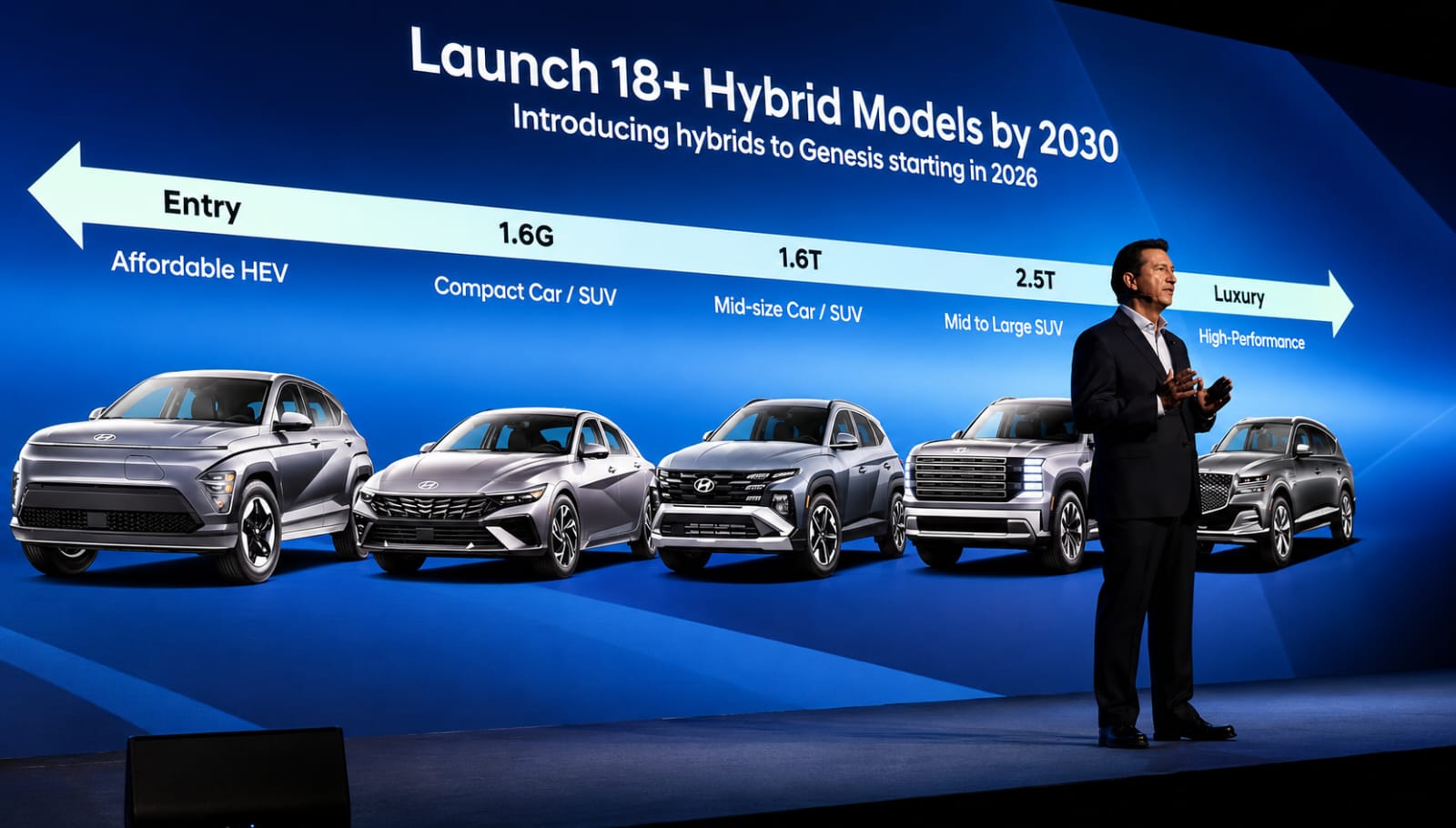
Hyundai is shifting its global electrification strategy into overdrive. The Korean automotive giant has just announced a massive roadmap targeting 2030: a rollout of over 18 new hybrid models—spanning across both the core lineup and the luxury Genesis brand—alongside an expansion to 6 dedicated Ioniq EVs.
What does this massive product offensive mean for the market? Let’s break down the upcoming launch timelines, technical specifications, efficiency figures, and the engineering behind Hyundai’s multi-pathway strategy.
What’s the Big Announcement? (Simple Explanation)
Hyundai Motor Group has officially confirmed that by the year 2030, they will have:
18+ hybrid models across Hyundai and Genesis.
6 dedicated Ioniq EVs – think Ioniq 5, Ioniq 6, and more SUVs and sedans coming.
The goal? To become a top 3 global EV player and offer a clean energy option for every lifestyle – from sporty sedans to family SUVs.
Why this matters: Hyundai is admitting that not everyone is ready for a full EV yet. So they’re doubling down on hybrids as a “bridge” while building a pure-electric future with Ioniq.
Launch Dates & Timeline (When Can You Buy?)
Hyundai hasn’t dropped exact month-by-month dates, but here’s the expected rollout:
Vehicle Type
Launch Window
Expected Markets First
New Hybrid models (Hyundai brand)
2025 – 2027
Korea, US, India
Genesis Hybrids (luxury)
2026 – 2028
Global (incl. India via CBU)
Ioniq 7 (3-row electric SUV)
Late 2025 – Early 2026
US, Europe, then India
Remaining 2 new Ioniq EVs
2027 – 2030
Global rollout
Note for Indian buyers: Hyundai India will likely get popular hybrids like the new Hyundai Creta Hybrid and Santa Fe Hybrid by 2026. The Ioniq 6 and Ioniq 7 are expected in India by 2026–27.
Ioniq 5 (existing) – Range: 631 km (ARAI) / 481 km (WLTP)
Ioniq 6 (coming) – Range: ~610 km WLTP
Ioniq 7 (future) – Range: ~550–600 km WLTP (3-row SUV)
Charging speed for Ioniq EVs: All new Ioniq EVs will support 350kW DC fast charging – 10% to 80% in 18 minutes. Yes, faster than your phone charges sometimes.
Key Features You’ll Get in These Hyundai Hybrids & EVs
Hyundai is loading these cars with tech. Here’s what to expect:
V2L (Vehicle to Load) – Use your car to charge a laptop, fridge, or even another EV.
E-GMP Platform (for EVs) – Flat floor, more interior space, 800V fast charging.
Smart Regenerative Braking – Adjusts automatically using navigation data (turns braking into battery).
Over-the-Air (OTA) Updates – Your car’s software, battery, and even safety features update like a smartphone.
How to Get One? (Simple Process – For India Buyers)
Once these cars launch in India (likely 2026 onwards), here’s the step-by-step:
Book online or at dealership – Hyundai will open bookings on their official website.
Choose variant – For hybrids: usually 2–3 trims (Executive, Premium, Top). For Ioniq EVs: single fully-loaded trim.
Financing – Many banks offer green car loans at lower interest (0.2–0.5% less than normal).
Home charging setup (for EVs) – Hyundai will send a technician to install a 7.2kW or 11kW AC wall box. Cost often included in the purchase.
Delivery & RTO registration – EVs pay 0 road tax in some states (like Delhi, UP, Maharashtra). Hybrids have 5–10% lower tax than pure petrol.
Pro tip: If you want the Ioniq 6 or Ioniq 7, register for early interest on Hyundai’s global site. India gets limited units first.
Important Documents Needed (When Booking)
Keep these ready for a smooth purchase:
For Hybrids / EVs:
Aadhaar card + PAN card
Driving license (valid)
Address proof (passport, electricity bill, etc.)
Last 3 months’ bank statement or salary slip (for loan)
For EV-specific subsidies (if available):
FAME-II (or newer FAME-III) subsidy form – dealer will help fill.
State EV policy declaration (some states give extra ₹1.5–2 lakhs off).
Eligibility Criteria – Who Can Buy?
Honestly, almost anyone with a valid license. But for subsidies or loans:
Category
Eligibility
EV subsidy (FAME)
Only for 1st owner. Car must be registered as personal (not taxi).
Green loan
CIBIL score 750+. Income proof required for EVs above ₹25 lakh.
Corporate / Fleet
Companies can claim 80% depreciation on EVs in year 1.
Non-resident Indians (NRI)
Yes, but need an Indian address and local bank account.
No upper age limit. Even first-time drivers can buy (but maybe avoid the 600 bhp Genesis hybrid 😅).
A Quick Comparison – Why Hyundai Over Tata or Mahindra?
Feature
Hyundai (Ioniq/Hybrid)
Tata (EV)
Mahindra (EV)
Fast charging
350kW (18 min)
150kW (30-40 min)
175kW (25-30 min)
Hybrid options
18 models by 2030
Very limited
None planned
Global safety
Euro NCAP 5-star
Global NCAP 5-star
5-star expected
V2L feature
Yes (3.6kW output)
Limited models
No
Hyundai’s biggest edge?Variety. You can walk into a showroom and pick a hybrid SUV, a sporty EV sedan (Ioniq 6), or a luxury Genesis hybrid.
Short Note Mein Baat (Hyundai’s big 2030 vision)
Bhai, Hyundai ne 2030 tak plan bana diya hai – 18+ hybrid models (Creta, Tucson, Genesis sab aayega) aur 6 full Ioniq EVs. Kya khaas hai? Fast charging 18 min mein, V2L (car se ghar chalao), aur 20+ km/l mileage hybrid mein.
Ioniq 7 (bada electric SUV) 2025 end tak expected. India mein Creta Hybrid pehle aayega – lagbhag 22 km/l. Agar EV ya hybrid lene ka soch rahe ho, toh wait kar lo. Worth it hai.
Bas itna yaad rakho: Hybrid = no tension long drive. Ioniq EV = no petrol bill ever. Done. 🔌⚡
Final Take(Hyundai’s big 2030 vision)
Hyundai’s dual-track approach is a calculated move. Recognizing that full EV adoption is a gradual process, the brand is scaling up its 18-hybrid portfolio to capture buyers demanding fuel efficiency without range anxiety. Concurrently, its 6-model Ioniq EV lineup is positioned to compete directly for market share against Tesla and BYD.
For the Indian market, this product offensive is already taking shape, with the first wave of advanced hybrids and the flagship Ioniq 7 slated to make their debut in the coming months.
Would you pick a hybrid or go all-electric? Let me know in the comments. 🚗💨

Leave a Reply